Without the stories and the songs, I am mute. A white American education will never give them to me but it can—if I am graced, if I do not go blind in the white light of self-consciousness, if I have guides before me and the sense to heed them—it can help me see the stories, growing like a vine out of the cane fields, up out of unmarked graves, around me soul. It can help me search out the very history it did not teach me. (237)
"I mean, there's so much here, it seems almost like a waste to come back and give more. It's good for the minority kids, I'm sure...But there's so much to do outside this...bubble. I wonder if we aren't practically obliged to give it back elsewhere, to people who never got it in the first place..."
"I do give it back elsewhere," I said. I was glad that I felt no anger. I had heard the argument in my mind so many times. Now there was no anger, and I could smile. "But I don't feel that there's anything wrong in giving it here, too. It is like admitting who I am. I came here, and I went away changed. I've been fighting that for a long time, to no purpose. I am a crossover artist, you know, like those jazz musicians who do pop albums too." (232-233)
The faculty that had appeared to my teenaged eyes as a monolith of critical white adulthood now revealed itself as a community of idealists, all trying, each according to his or her ability, to help young people (225).
For the first time that year, I was not ready to leave St. Paul's. I had had all my time, all my chances. I could never do it again, never made it right. I had not loved enough (219).
This time Izzy will jump of her own will when her legs have grown strong enough to absorb the shock; she will not lie on the ground, splayed out alone, crippled by distrust. She will learn how to jump up through life, big, giant steps. She'll fall, and get up again. Up, Izzy, up. Paint, dance, read, sing, skate, write, climb, fly. Remember it all, and come tell us about it. (237-238).
There you have it. Lorene: from working class Yeadon to St. Paul's School, two marriages and a child named Laura, a teacher and trustee of St. Paul's, and finally a writer of a story about a fifteen year old "overserious" (232) girl who leaves the comfort of home for a mysterious place in New Hampshire. She went; she changed. Here she is in 2013 getting an honorary degree from Swarthmore. She's a literature teacher at her alma mater, Penn. She's a professional writer. She's done all right for herself.
I hope you all had a restful break. We'll finish our discussion of the book over the next couple days. I will give you your short paper topic. Maybe we can watch one more movie. And you'll have time to work on your big paper in class before it is due on the last day of the semester.
1. What moment in this last part of the reading stayed with you? Why?
2. So what is this book about? What did you get from it at the end—what was Cary wanting to say in this book about a girl going to prep school (like you are doing)? Quote 2-3 times in your response. Think about this, okay?
3. Your response to this book? Like? Dislike? Why?
See you all tomorrow.

Sunday, November 27, 2016

Sunday, November 20, 2016
Blog Twenty Five. Black Ice Through Eleven. "I Spoke Clearly and Precisely..."
"...conscious, as the smell of vomit wafted sweet and sour off Booker's breath through the open window, of the confident speech St. Paul's had given me" (169).
"Let me go."
"You too good?"
"Get your motherfuckin' hands off of me."
"Don't talk like that." He gave my torso another squeeze and opened the door. "You got a nasty mouth sometimes," he said, holding the jar ajar. "You'd better just make sure to keep it closed." (160)
He asked me whether or not I had messed around with any of the other men. I did not feel indignant when he asked me these questions, so I intent was I on telling my story and making him listen (161).
"Next thing you'll be turning us in."
According the Honor Code, that's what I was supposed to do. I did not think it would my case to point out that at the present moment I was being lenient.
"I really didn't think you'd take it this way," said Janie.
"Neither did I." [...] I didn't want her to think I'd joined the establishment, but the truth was that, in a way, I had. (180)
I learned to think of misbehavior as a symptom rather than a disease (193).
India and I talked often and late into the night after that. We raged together at St. Paul's School—at its cliques and competitiveness; its ambivalence toward its new female members; its smugness and certainty and power. We talked about families and boyfriends, girls we liked and girls we didn't. We laughed at how we had appeared to each other the year before. Our talk was therapeutic, private, and as intense as romance. It was for me the first triumph of love over race. (199)
The following is a blog written by a student back in the spring of 2015. It raises good questions. Pick one of the two questions the student posed. And answer the third that I ask.
In the past two chapters, we have seen Lorene begin to feel as if she finds her place and embraces her positions of authority as a senior at St. Paul’s. Throughout the book previously, Lorene has struggled with feeling separate and cut off from the school’s environment and traditions, but now she begins to embrace them, realizing, as she says, that she has “…brought a whole bunch of new ideas that haven’t been here until now” (195).
As Lorene begins to fill her new rolls—as a senior, Vice President, tutor, even teacher at one point—she struggles between taking advantage of St. Paul’s and being an active member of the community while maintaining her own identity and her history. She is struggling to do exactly as Mr. Vernon Jordan says, to “…be the best that you can, so that when you come out, you’ll be ready. But you cannot forget where you’ve come from”(202). This point is brought up again with Jimmy and his disciplinary case. On one hand, his experience does him good, but it also subdues him in a way that some may see as not entirely positive.
1. How do we see Lorene struggle with this difficult balance of assimilation vs. maintaining her identity? What are your opinions on Jimmy’s disciplinary case? Do you think this balance between embracing St. Paul’s and maintaining personal identity is important or even possible?
We also see Lorene continue to find common ground and forge new relationships she never thought she would have, like her new friendship with India. Although this shows her growth, Lorene must begin to grapple with her own changing identity and the privileges she now has that she never previously self-identified with. This is highlighted with Lorene’s conversation with Archibald Cox, his not so sly “Our kind of people” (201) comment.
2. So, what did you make of Archibald Cox and Lorene’s quick interaction, more specifically, the “our kind of people” comment? Is there a difference between finding common ground, like Lorene and India do, and dividing yourself into groups (especially privileged groups) like the “educated Northeastern establishment” into which both Cox and now Lorene fall? Is there any difference between these groups based on mutual privilege and something like the Third World Coalition?
And for everyone:
3. It seems clear to me that St. Paul's has changed Lorene—and in a positive way. Agree or disagree with that statement. And offer some support for your opinion.
Ok, folks. See you all tomorrow. And I thought the discussion on Thursday was a good one. Thanks for the honesty, openness, and trust.
"Let me go."
"You too good?"
"Get your motherfuckin' hands off of me."
"Don't talk like that." He gave my torso another squeeze and opened the door. "You got a nasty mouth sometimes," he said, holding the jar ajar. "You'd better just make sure to keep it closed." (160)
He asked me whether or not I had messed around with any of the other men. I did not feel indignant when he asked me these questions, so I intent was I on telling my story and making him listen (161).
"Next thing you'll be turning us in."
According the Honor Code, that's what I was supposed to do. I did not think it would my case to point out that at the present moment I was being lenient.
"I really didn't think you'd take it this way," said Janie.
"Neither did I." [...] I didn't want her to think I'd joined the establishment, but the truth was that, in a way, I had. (180)
I learned to think of misbehavior as a symptom rather than a disease (193).
India and I talked often and late into the night after that. We raged together at St. Paul's School—at its cliques and competitiveness; its ambivalence toward its new female members; its smugness and certainty and power. We talked about families and boyfriends, girls we liked and girls we didn't. We laughed at how we had appeared to each other the year before. Our talk was therapeutic, private, and as intense as romance. It was for me the first triumph of love over race. (199)
The following is a blog written by a student back in the spring of 2015. It raises good questions. Pick one of the two questions the student posed. And answer the third that I ask.
In the past two chapters, we have seen Lorene begin to feel as if she finds her place and embraces her positions of authority as a senior at St. Paul’s. Throughout the book previously, Lorene has struggled with feeling separate and cut off from the school’s environment and traditions, but now she begins to embrace them, realizing, as she says, that she has “…brought a whole bunch of new ideas that haven’t been here until now” (195).
As Lorene begins to fill her new rolls—as a senior, Vice President, tutor, even teacher at one point—she struggles between taking advantage of St. Paul’s and being an active member of the community while maintaining her own identity and her history. She is struggling to do exactly as Mr. Vernon Jordan says, to “…be the best that you can, so that when you come out, you’ll be ready. But you cannot forget where you’ve come from”(202). This point is brought up again with Jimmy and his disciplinary case. On one hand, his experience does him good, but it also subdues him in a way that some may see as not entirely positive.
1. How do we see Lorene struggle with this difficult balance of assimilation vs. maintaining her identity? What are your opinions on Jimmy’s disciplinary case? Do you think this balance between embracing St. Paul’s and maintaining personal identity is important or even possible?
We also see Lorene continue to find common ground and forge new relationships she never thought she would have, like her new friendship with India. Although this shows her growth, Lorene must begin to grapple with her own changing identity and the privileges she now has that she never previously self-identified with. This is highlighted with Lorene’s conversation with Archibald Cox, his not so sly “Our kind of people” (201) comment.
2. So, what did you make of Archibald Cox and Lorene’s quick interaction, more specifically, the “our kind of people” comment? Is there a difference between finding common ground, like Lorene and India do, and dividing yourself into groups (especially privileged groups) like the “educated Northeastern establishment” into which both Cox and now Lorene fall? Is there any difference between these groups based on mutual privilege and something like the Third World Coalition?
And for everyone:
3. It seems clear to me that St. Paul's has changed Lorene—and in a positive way. Agree or disagree with that statement. And offer some support for your opinion.
Ok, folks. See you all tomorrow. And I thought the discussion on Thursday was a good one. Thanks for the honesty, openness, and trust.
Sunday, November 13, 2016
Blog Twenty Four. Black Ice Through Chapter 6. "Everywhere I Went I Felt Out Of Place." (100)
The fact was that I had left home in September gleeful and smug. I took it as divine justice that now I felt as if I no loner belonged anywhere (100).
I felt betrayed, first by them, then by my own naivety. HP were probably what they'd meant by fine—for black scholarship kids, Maybe that's what they'd been saying all along, only I hadn't heard it (87).
"...but I always kind of wondered if, like, black guys and white guys were, like, different..." (86).
It couldn't be just that I was to become like them or hang onto what I'd been. It couldn't be that lonely and pointless (86).
"You don't know them, and believe me, they could just be waiting for you to make a mistake. Do you hear me? Don't you go running to those people" (40).
I looked at Ruthie hard and tried to judge whether or not I could trust her. All I could see as I looked at her, however, were her snow boots. She always had the appropriate footwear, I thought, conscious of my wet feet. Ruthie tossed her cornsilk hair...
"Listen, Ruthie. My friend is here. He'll be here, at school, in minutes." (105)
I thought I loved this muscular young man with the sparkling smile. I could not understand why I was relieved to see him go, or why his ardent letters embarrassed me (112).
That, I thought, was real stealing, done, no doubt, by some rich kleptomaniac, the same one who had probably eaten my cheese and crackers the week before (113).
Well, you probably didn't see much of this coming (besides Jaliwa who read Chapter 5 already). Lorene is a mess. "Everywhere I felt out of place." Her ambitions are being reduced as she struggles through her classes. The girls ask her about black men's masculinity ("the old song of the South" [84]). Can she trust the well-to-do white kids? Does she listen to her mother who urges her not to trust them? She's raped by her beautiful boyfriend Ricky. She begins to steal from her classmates.
She tells no one what is happening with her. And what is happening to her is something terrible.
So what's going on with Lorene? Why not reveal herself? Why not reach out? Why not hit Ricky? Why not tell her girlfriends at school the way their questions make her feel? And how much of what is going on with her can be laid at the feet of St. Paul's School, which she makes fun of to her hometown friends, but where she can hang with the pimply young white science kids on the Astronomy Club and laugh—away from her "cooler friends" (103)?
Write an answer of the usual length, okay? And quote 2-3 times in your response. And feel free to respond to your classmates: agree, disagree, question. See you all tomorrow.
I felt betrayed, first by them, then by my own naivety. HP were probably what they'd meant by fine—for black scholarship kids, Maybe that's what they'd been saying all along, only I hadn't heard it (87).
"...but I always kind of wondered if, like, black guys and white guys were, like, different..." (86).
It couldn't be just that I was to become like them or hang onto what I'd been. It couldn't be that lonely and pointless (86).
"You don't know them, and believe me, they could just be waiting for you to make a mistake. Do you hear me? Don't you go running to those people" (40).
I looked at Ruthie hard and tried to judge whether or not I could trust her. All I could see as I looked at her, however, were her snow boots. She always had the appropriate footwear, I thought, conscious of my wet feet. Ruthie tossed her cornsilk hair...
"Listen, Ruthie. My friend is here. He'll be here, at school, in minutes." (105)
I thought I loved this muscular young man with the sparkling smile. I could not understand why I was relieved to see him go, or why his ardent letters embarrassed me (112).
That, I thought, was real stealing, done, no doubt, by some rich kleptomaniac, the same one who had probably eaten my cheese and crackers the week before (113).
Well, you probably didn't see much of this coming (besides Jaliwa who read Chapter 5 already). Lorene is a mess. "Everywhere I felt out of place." Her ambitions are being reduced as she struggles through her classes. The girls ask her about black men's masculinity ("the old song of the South" [84]). Can she trust the well-to-do white kids? Does she listen to her mother who urges her not to trust them? She's raped by her beautiful boyfriend Ricky. She begins to steal from her classmates.
She tells no one what is happening with her. And what is happening to her is something terrible.
So what's going on with Lorene? Why not reveal herself? Why not reach out? Why not hit Ricky? Why not tell her girlfriends at school the way their questions make her feel? And how much of what is going on with her can be laid at the feet of St. Paul's School, which she makes fun of to her hometown friends, but where she can hang with the pimply young white science kids on the Astronomy Club and laugh—away from her "cooler friends" (103)?
Write an answer of the usual length, okay? And quote 2-3 times in your response. And feel free to respond to your classmates: agree, disagree, question. See you all tomorrow.
Thursday, November 10, 2016
Blog Twenty Three. Black Ice Through Chapter 4. "Listen To Me, Darling," He Said. "We're Going To Turn This Motherfucker Out!" (57).
And why not? I, too, had been raised for it. My mother and her mother, who had worked in a factory, and her mother, who had cleaned apartments in Manhattan, had been studying these people all their lives in preparation for this moment. And I had studied them. I studied my mother as she turned out elementary schools and department store...Turning out had to do with will. I came to regard my mother's will as a force of nature, an example of and a metaphor for black power and black duty. My duty was to compete in St. Paul's classrooms. I had no option but to succeed and no doubt that I could will my success.
Jimmy understood. He knew the desperate mandate, the uncompromising demands, and the wild, perfect, greedy hope of it. If we could succeed here—earn high marks, respect, awards; learn these people, study them, be in their world but not of it—we would fulfill the prayers of our ancestors...How we got there, how we found their secret hideout, was not the point. The point was that we had been bred for it just as surely as they. The point was that we were there to turn it out. (57-59)
I had heard from one of the girls that three guys had once stolen into Sam's room and urinated into his bureau drawer. I wondered if it was true. I wondered if Cash had been one of them. (78)
What did these white people say in a hundred ways but that we were somehow different from the common run of black people out there in America? What did they say but that we were special, picked out for a special destiny? I was ashamed even to consider the possibility, but it was hard not to believe sometimes. How could I know that my special aloneness united me with my peers more surely than the wary, competitive fraternity I tried to create in my own heart? (78-79)
Tomorrow I hope we can really leap into Lorene's story. At the same time I have enjoyed and appreciated the candidness and honesty of what many of you have been saying in class the last couple days. I have appreciated hearing your stories. I'm thinking about what Agasha said today about the burden of responsibility—about having a mission, a responsibility to others, and having your own life (my summary in my words), and how hard it is to satisfy both. I'm also thinking about what Alice wrote on the last blog:
This book, this woman’s story, I know will be good for me, will teach me, but even then, I feel guilty for making her teach me. She shouldn’t have to educate me in empathy and understanding by sharing the most intimate stories of her past, but she does. I feel like I’m exploiting her. I realize she wants to share this story, but as she says, “I am writing this book to become part of that unruly conversation, and to bring my experience back to the community of minds that made it possible,”, this story isn’t meant for me. I know that sounds like an excuse for not putting myself out there to receive the messages she’s so clearly sending, but that’s how I feel.
1. What moment or scene in Chapter 4 particularly jumped out at you, stayed with you? And why?
2. Lorene, after her meeting with the Third World Coalition, speaks to feeling alone, even among her fellow students of color. Why might that be?
3. For this third question, please pick one of the following choices to respond to:
a. Stuart said today—and Agasha and Alice chimed in, as was Moey about to (sorry about that, Moey)—that the responsibility Lorene feels, as does her pal Jimmy and no doubt many of the other black kids, to succeed and to "turn it out" is not fair; it should not be expected of them. Do you agree with this or disagree—and why?
b. Read what Alice wrote: respond to it.
c. Lorene writes in the first passage that she would fulfill her ancestors prayers by succeeding at St. Pauls and being in the privileged world of SPS but not of it. Can one be in a place like St. Paul's—or even Paideia—and be in it but not of it? How is that as a plan to succeed for Lorene and for the other black students at St. Paul's? A good one? A bad one? Is it even possible?
Okay, folks: remember to turn your paper in tomorrow if you haven't done so already. See you then.
Jimmy understood. He knew the desperate mandate, the uncompromising demands, and the wild, perfect, greedy hope of it. If we could succeed here—earn high marks, respect, awards; learn these people, study them, be in their world but not of it—we would fulfill the prayers of our ancestors...How we got there, how we found their secret hideout, was not the point. The point was that we had been bred for it just as surely as they. The point was that we were there to turn it out. (57-59)
I had heard from one of the girls that three guys had once stolen into Sam's room and urinated into his bureau drawer. I wondered if it was true. I wondered if Cash had been one of them. (78)
What did these white people say in a hundred ways but that we were somehow different from the common run of black people out there in America? What did they say but that we were special, picked out for a special destiny? I was ashamed even to consider the possibility, but it was hard not to believe sometimes. How could I know that my special aloneness united me with my peers more surely than the wary, competitive fraternity I tried to create in my own heart? (78-79)
Tomorrow I hope we can really leap into Lorene's story. At the same time I have enjoyed and appreciated the candidness and honesty of what many of you have been saying in class the last couple days. I have appreciated hearing your stories. I'm thinking about what Agasha said today about the burden of responsibility—about having a mission, a responsibility to others, and having your own life (my summary in my words), and how hard it is to satisfy both. I'm also thinking about what Alice wrote on the last blog:
This book, this woman’s story, I know will be good for me, will teach me, but even then, I feel guilty for making her teach me. She shouldn’t have to educate me in empathy and understanding by sharing the most intimate stories of her past, but she does. I feel like I’m exploiting her. I realize she wants to share this story, but as she says, “I am writing this book to become part of that unruly conversation, and to bring my experience back to the community of minds that made it possible,”, this story isn’t meant for me. I know that sounds like an excuse for not putting myself out there to receive the messages she’s so clearly sending, but that’s how I feel.
1. What moment or scene in Chapter 4 particularly jumped out at you, stayed with you? And why?
2. Lorene, after her meeting with the Third World Coalition, speaks to feeling alone, even among her fellow students of color. Why might that be?
3. For this third question, please pick one of the following choices to respond to:
a. Stuart said today—and Agasha and Alice chimed in, as was Moey about to (sorry about that, Moey)—that the responsibility Lorene feels, as does her pal Jimmy and no doubt many of the other black kids, to succeed and to "turn it out" is not fair; it should not be expected of them. Do you agree with this or disagree—and why?
b. Read what Alice wrote: respond to it.
c. Lorene writes in the first passage that she would fulfill her ancestors prayers by succeeding at St. Pauls and being in the privileged world of SPS but not of it. Can one be in a place like St. Paul's—or even Paideia—and be in it but not of it? How is that as a plan to succeed for Lorene and for the other black students at St. Paul's? A good one? A bad one? Is it even possible?
Okay, folks: remember to turn your paper in tomorrow if you haven't done so already. See you then.
Sunday, November 6, 2016
Blog Twenty Two. Black Ice, 3-34. "Who At St. Paul's Would Stand Up For Her Child In Her Stead?" (7).
Lorene Cary first heard about St. Paul's School 45 years ago when she was 14. Interestingly enough, that was also the first year of The Paideia School. The school Lorene attending all those years ago was about as far away from this school as one could be at the time. Today...well, that's another story.
What Lorene did all those years ago was probably being mirrored all across America. The Private School, the (College) Preparatory School, the Independent School (a term I'm not sure existed back then—it sounds so less loaded the private or prep school)—particularly the ones in New England that had existed for hundreds of years (like Phillips Academy in Andover, MA, founded in 1778, Phillips Exeter in Exeter, NH, founded in 1781, Deerfield Academy, Deerfield, MA, founded 1797, and, yes, St. Paul's School, founded in 1857)—were (and are) feeders for the Ivy Leagues. As Lorene knew even at 14: "I wanted to know the things [Mike Russell] must know: about science and literature and language, living away from home, New England, white people, money, power, himself." Power: even in Darby, a working class section of Philadelphia, she knew what what a New England prep school could bring. And about the time St. Paul's sent out students like Mike Russell and teachers like Jeremy Price, these schools, like St. Paul's, were finally admitting girls. And almost immediately, Lorene decides, "I had to be part of that. With the force of religious conversion, the great God of education moved within me, an African Methodist God with a voice that boomed like thunder. It took all my strength to hold myself inside my skin. This school—why, this was what I had been raised for, only I hadn't known it" (12). Years later, though, she acknowledges:
But I would not admit how profoundly St. Paul's had shaken me, or how damaged and fraudulent and traitorous I felt when I graduated. In fact, I pretended for so long that by the time I was twenty-six years old, I was able to convince myself that going back to school to teach would be the career equivalent of summering with distant, rich relatives. (4)
This is all happening to a fifteen year old girl who has never really left her home city, doesn't really know that much about the world outside her "enclave of black professionals, paraprofessionals, wish-they-was—, look-like, and might-as-well-be professionals, as we called ourselves" (9). Lorene is on a mission—"This school—why, this was what I had been raised for, only I hadn't known it." But can one argue that she even came out ahead of the game, feeling "black and ugly"? "Had they done that to me? Had somebody else? Had I let them? Could I stop the feelings? Or hide them?" (5). Lorene Cary indeed was a trailblazer: one of the first girls in what had been an exclusively male school since 1855. And one of the first African-American girls in what had been an almost exclusively white world. How could this have gone right or smoothly? Or could it have?
I'd propose one of the major questions that Cary asks in her memoir is this: Was the experience worth it? As Sylvia Snyderman pointed out two years ago when I last taught this book, Cary seems to contradict herself. This place, this experience, that so seemed to scar her—to bring her so quickly back to her own feelings of powerlessness that she felt as an adolescent at the school—was not "an aberration from the common run of black life in America. The isolation I'd felt was an illusion" (6). That's one powerful illusion she felt. St. Paul's is hers because she went there—but did it have to be such a daunting experience? And if so, was it the fault of the school—had "they" done it to her? Had she "let them" do it to her? Was this simply a part of growing up? The memoir poses so many questions—and the answers, no surprise, are not easy, not easily reduced to "illusion," no matter how Lorene Cary may feel about them. In my opinion. So...
1. Reactions to the book so far? What moment in it particularly jumped out at you in either a positive or negative way—and why—how so? Please quote.
2. Your reactions to Lorene Cary? Do you like her? Dislike her? Relate to her? What moment in the book so far jumps out at you that helps define this precocious young woman for you, positively or negatively? Please quote.
3. I'm curious, and it does tie in with Lorene's journey. Why did you come to Paideia School?
The St. Paul's website is here. Take a look at it. It looks remarkably like Paideia's website, I think. Take away the more formal dress of some of the boys, stick the pictures on our webpage, and no one would know the difference. The tuition is a little over $60,000. The school was in the news recently for a sex scandal involving a senior boy and a 15 year old female student.
This is Lorene Cary's website.
See you all Tuesday.
Monday, October 31, 2016
Blog Twenty One. Apocalypse Now. "But It's Judgement That Defeats Us."
It's
impossible for words to describe what is necessary for those who do not
know what horror means. Horror. Horror has a face. And you must make a
friend of horror. Horror and mortal terror are your friends. If not,
then they are enemies to be feared. They are truly enemies...I remember
when I was with Special Forces—it seems a thousand centuries ago—we
went into a camp to inoculate the children. We’d left the camp after we
had
inoculated the children for polio and this old man came running after us
and he
was crying, and he couldn’t see. We went back there and they had hacked
off
every inoculated arm and there they were in a pile, a pile of little
arms and I
remember I...I...I cried. I wept like some grandmother. I wanted to tear
my teeth
out. I didn’t know what I wanted to do and I want to remember it, I
never want
to forget it. I never want to forget, and then I realized like I was
shot, like
I was shot with a diamond—a diamond bullet went through my forehead—and I
thought, my God, the genius of that. The genius, the will to do that.
Perfect,
genuine, crystalline, pure. And then I realized they were stronger than
us,
because they could stand it. These were not monsters, these were men,
trained
cadres, who have children, who are filled with love. But they have the
strength,
the strength, to do that. If I had ten divisions of these me then our
troubles
here would be over very quickly. You have to have men who are moral and
at the
same time able to use their primordial instincts to kill without,
feeing,
without passion, without judgement, without judgement. Because
it’s judgement that defeats us...I worry that my son might not
understand what I've tried to be. And if I were to be killed, Willard, I
would want someone to go to my home and tell my son
everything...Everything I did. Everything you saw. Because there's
nothing I detest more than the stench of lies. And if you understand me,
Willard, you will do that for me.
We train young men to drop fire on people, but their commanders won't allow them to write "fuck" on their airplanes because it's obscene.
Much of what Kurtz says in the last 30 minutes of the movie was improvised by Brando. That was partly because Coppola had no real end to the film (so the story goes): or at least an end that tied up what he was doing with the hours and hours of footage he had already shot. Partly this happened because Brando was screwing with the man who directed him to an Oscar for The Godfather—Brando was notorious for not taking acting seriously (he got paid the unheard of sum in 1978 of $2 million for what was essentially 30 minutes of screen time). The ending has always been criticized for many reasons—Mira, you're not alone in criticizing the ending. Yet it also remains strangely and stubbornly true to Conrad's vision. As the photojournalist says, "This is the way the fucking world ends. Look at this...shit we're in, man! Not with a bang, a whimper," quoting "The Hollow Men" by T.S. Eliot. In Heart of Darkness, perhaps, as we discussed, the true darkness is not back there in the jungles, but in London, where Marlow chooses to lie about the way he saw the world end. Arguably, Apocalypse Now ends on a much more optimistic note than its forebearer.
This is a difficult film, no doubt. It's relentless: like its source, it offers little light. Its relentless intensity, its commitment to a singular vision, its unsparing take on a vision of the world that seems to offer little hope—no tending your garden here—is exhausting. More so than ever today, where a popular film would never attempt to challenge its audience the way this did (again: this was nominated for several Academy Awards; it was a relatively successful film—I certainly saw it in a packed theater). Crowds chose to see this—pundits and critics and academics debated this seriously. It pushed the envelope—but it remained mainstream. There is a good chance that had you been 17 or 18 in 1978, or 19 or 20, you would have gone to see this movie. Now is a different story.
So:
The long italicized passage quoted at the top—the polio speech. I think it's the most important passage in the film. It is Kurtz's epiphany: it's the moment he decides to go all the way. (In Chef's terminology, it's the moment he "gets off the boat") What's your response to the position Kurtz states here? Does it make any sense whatsoever? Does it follow any degree of logic, of rationality? Or is the ravings of a madman? Or can it be both rational and insane? Here it is—go ahead and watch it.
Take some time to answer this question. This is the last blog you'll have until we start Black Ice next week. Doing this at 7 in the morning is not a good idea. Or if you do, don't rush through it. Again, this is as intense a film as we will watch this year. Next up: Lorene Cary goes to prep school in New Hampshire. It isn't as easy as it sounds. See you guys tomorrow.
We train young men to drop fire on people, but their commanders won't allow them to write "fuck" on their airplanes because it's obscene.
Much of what Kurtz says in the last 30 minutes of the movie was improvised by Brando. That was partly because Coppola had no real end to the film (so the story goes): or at least an end that tied up what he was doing with the hours and hours of footage he had already shot. Partly this happened because Brando was screwing with the man who directed him to an Oscar for The Godfather—Brando was notorious for not taking acting seriously (he got paid the unheard of sum in 1978 of $2 million for what was essentially 30 minutes of screen time). The ending has always been criticized for many reasons—Mira, you're not alone in criticizing the ending. Yet it also remains strangely and stubbornly true to Conrad's vision. As the photojournalist says, "This is the way the fucking world ends. Look at this...shit we're in, man! Not with a bang, a whimper," quoting "The Hollow Men" by T.S. Eliot. In Heart of Darkness, perhaps, as we discussed, the true darkness is not back there in the jungles, but in London, where Marlow chooses to lie about the way he saw the world end. Arguably, Apocalypse Now ends on a much more optimistic note than its forebearer.
This is a difficult film, no doubt. It's relentless: like its source, it offers little light. Its relentless intensity, its commitment to a singular vision, its unsparing take on a vision of the world that seems to offer little hope—no tending your garden here—is exhausting. More so than ever today, where a popular film would never attempt to challenge its audience the way this did (again: this was nominated for several Academy Awards; it was a relatively successful film—I certainly saw it in a packed theater). Crowds chose to see this—pundits and critics and academics debated this seriously. It pushed the envelope—but it remained mainstream. There is a good chance that had you been 17 or 18 in 1978, or 19 or 20, you would have gone to see this movie. Now is a different story.
So:
The long italicized passage quoted at the top—the polio speech. I think it's the most important passage in the film. It is Kurtz's epiphany: it's the moment he decides to go all the way. (In Chef's terminology, it's the moment he "gets off the boat") What's your response to the position Kurtz states here? Does it make any sense whatsoever? Does it follow any degree of logic, of rationality? Or is the ravings of a madman? Or can it be both rational and insane? Here it is—go ahead and watch it.
Take some time to answer this question. This is the last blog you'll have until we start Black Ice next week. Doing this at 7 in the morning is not a good idea. Or if you do, don't rush through it. Again, this is as intense a film as we will watch this year. Next up: Lorene Cary goes to prep school in New Hampshire. It isn't as easy as it sounds. See you guys tomorrow.
Friday, October 28, 2016
Blog Twenty. Apocalypse Now. "Our Motto: Apocalypse Now."
LANCE.  Where'd the dog go?  Where's the dog?  We gotta go back and get the
dog!
Chef crawls to Clean and turns him over.  Sees that he is dead.
CHEF. Clean!  Hey!  Bubber, you can't die!  You fucker!  Hey, bubber!
CLEAN'S MOTHER (INTO RECORDER). "I'll have a lot of grandchildren to love and spoil,
and then when your wife gets them back, she's be mad with me.  Even Aunt Jessie and
Mama will come to celebrate your coming home.  Granny and Dad are trying to get
enough money to get you a car.  But don't tell them, because that's our secret.
Anyhow..."
Clean lying dead, flat on his back.  Chief turns him over and holds his wrist to try
and take his pulse.
CLEAN'S MOTHER (INTO RECORDER. "...do the right thing, stay out  of the way of the
bullets, and bring your hiney home ask in one piece...'cause we love you very
much.  Love, Mom."
PHOTOJOURNALIST. The man's enlarged my mind. He's a poet-warrior in a classic sense.
I mean, sometimes he'll-well, you say hello to him, right? And he'll just walk
right by you and he won't even notice you. And then suddenly he'll grab you and
he'll throw you  in a corner and he'll say "Do you  know that the 'if' is the middle
word in 'life'?  If you can keep your head when all about you are losing theirs and
blaming it on you.  If you can trust yourself when all men doubt you." I'm a
little man, I'm a little man. He's a great man. "I should have been a pair of ragged
claws scuttling across floors of silent seas."
WILLARD. They told me, that you had gone...totally insane. And that your methods
were unsound.
KURTZ. Are my methods unsound?
WILLARD. I don't see any method at all, sir.
KURTZ. I expected someone like you.  What did you expect?  Are you an assassin?
WILLARD. I'm a soldier.
KURTZ. You're neither.  You're an errand boy, sent by grocery clerks, to
collect a bill.
Operation Brute Force. That's what the soldiers, marines, and sailors are being rewarded for with the Playboy Bunnies. As I said in class today, this is a parody of the USO shows that traveled around Vietnam, entertaining the troops: always popular in those shows were the Hollywood starlets like Ann-Margret and Rachel Welch, singers and dancers, comedians, professional athletes, and even Playboy bunnies—though not like this. Critics often have commented on their costumes—cowboys, Indians, and cavalry. Just like another war not too dissimilar to Vietnam. And critics—and viewers watching closely—can't help but notice the swipe of the nose by the Playmate of the Year. A little toot of cocaine perhaps to get her up for the show?

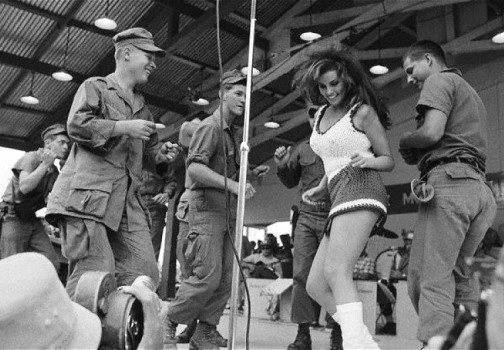
Arguably the film loses steam with the entrance today of Kurtz: Brando overweight and having improvised much of his own dialogue. But the attack on the village by Kilgore; the Playmates scene; and today, the deaths of Clean and Chief: they can't help but elicit a reaction from an audience. As Emma said in class today, the Playmates make no sense here. Then again, we're in a world of Generals who send assassins to kill their own officers; helicopter attacks set to the music of Wagner; and the horrific state of Kurtz's compound. More than ever, I feel unsettled as we make our way down the river in the movie. I can't see what you all look like during the movie: I hope you're all paying attention as difficult as this movie is.
Pick the first or the second question to answer. And everyone do number two and three.
1. The Playboy Bunny scene. Reaction to it? After you write that: why do you think it's here? The women egg the men on—act provocatively, entice them to come over (although I don't think they thought they actually would swim the moat)—but when the men come over, they begin happily signing the posters the men have: no one is groping them, just hoping for an autograph. At the same time we hear very clearly Lance (who loves puppies) shout, "You fucking bitch!" The guys on the boat are some of the loudest in the crowd of men—but they also are the most humanized men we see in the film. So: why? Are we supposed to feel disgust for the behavior of the men? At the behavior of the women? Both? Something else?
or
1. The death of Clean. We've seen Clean rake the sampan with his machine gun, killing a group of civilians. He calls the girl a "slope bitch" (I believe). Yet after all the carnage is done, as he lifts his shades, the look on his face says he can't—or almost can't—believe what he's done. At the Do Long bridge, he's like the scared kid he is as he watches the men get blown off the bridge. And Chief, as he's done throughout the movie, takes care of him. And when Clean is killed, Chief breaks down in tears as he holds Clean's hand. Some of you may have hated these men when they killed the civilians. What do you feel about them now, in and after this scene? And what was your reaction to this scene?
2. What stayed with you from today's viewing? And why?
3. The film is about.... Finish that thought in a thoughtful sentence. You may love the film or hate it or not care about it: but don't just give a quick, throwaway respone.
For one or two: give a detailed, thoughtful response as well. Not three sentences, but several.
We'll finish the film Monday. Look at the writing topics: tell me Monday what you're doing to write about.
Subscribe to:
Posts (Atom)