Sunday, November 6, 2016

Blog Twenty Two. Black Ice, 3-34. "Who At St. Paul's Would Stand Up For Her Child In Her Stead?" (7).


Lorene Cary first heard about St. Paul's School 45 years ago when she was 14.  Interestingly enough, that was also the first year of The Paideia School.  The school Lorene attending all those years ago was about as far away from this school as one could be at the time.  Today...well, that's another story.

What Lorene did all those years ago was probably being mirrored all across America.  The Private School, the (College) Preparatory School, the Independent School (a term I'm not sure existed back then—it sounds so less loaded the private or prep school)—particularly the ones in New England that had existed for hundreds of years  (like Phillips Academy in Andover, MA, founded in 1778, Phillips Exeter in Exeter, NH, founded in 1781, Deerfield Academy, Deerfield, MA, founded 1797, and, yes, St. Paul's School, founded in 1857)—were (and are) feeders for the Ivy Leagues.  As Lorene knew even at 14: "I wanted to know the things [Mike Russell] must know: about science and literature and language, living away from home, New England, white people, money, power, himself."  Power: even in Darby, a working class section of Philadelphia, she knew what what a New England prep school could bring.  And about the time St. Paul's sent out students like Mike Russell and teachers like Jeremy Price, these schools, like St. Paul's, were finally admitting girls.  And almost immediately, Lorene decides, "I had to be part of that.  With the force of religious conversion, the great God of education moved within me, an African Methodist God with a voice that boomed like thunder.  It took all my strength to hold myself inside my skin.  This school—why, this was what I had been raised for, only I hadn't known it" (12).  Years later, though, she acknowledges:

But  I would not admit how profoundly St. Paul's had shaken me, or how damaged and fraudulent and traitorous I felt when I graduated.  In fact, I pretended for so long that by the time I was twenty-six years old, I was able to convince myself that going back to school to teach would be the career equivalent of summering with distant, rich relatives. (4)

This is all happening to a fifteen year old girl who has never really left her home city, doesn't really know that much about the world outside her "enclave of black professionals, paraprofessionals, wish-they-was—, look-like, and might-as-well-be professionals, as we called ourselves" (9).  Lorene is on a mission—"This school—why, this was what I had been raised for, only I hadn't known it." But can one argue that she even came out ahead of the game, feeling "black and ugly""Had they done that to me? Had somebody else? Had I let them? Could I stop the feelings? Or hide them?" (5).  Lorene Cary indeed was a trailblazer: one of the first girls in what had been an exclusively male school since 1855. And one of the first African-American girls in what had been an almost exclusively white world. How could this have gone right or smoothly? Or could it have?

I'd propose one of the major questions that Cary asks in her memoir is this: Was the experience worth it? As Sylvia Snyderman pointed out two years ago when I last taught this book, Cary seems to contradict herself. This place, this experience, that so seemed to scar her—to bring her so quickly back to her own feelings of powerlessness that she felt as an adolescent at the school—was not "an aberration from the common run of black life in America. The isolation I'd felt was an illusion" (6). That's one powerful illusion she felt. St. Paul's is hers because she went there—but did it have to be such a daunting experience? And if so, was it the fault of the school—had "they" done it to her? Had she "let them" do it to her? Was this simply a part of growing up? The memoir poses so many questions—and the answers, no surprise, are not easy, not easily reduced to "illusion," no matter how Lorene Cary may feel about them. In my opinion.  So...

1. Reactions to the book so far? What moment in it particularly jumped out at you in either a positive or negative way—and why—how so? Please quote.

2. Your reactions to Lorene Cary? Do you like her? Dislike her? Relate to her?  What moment in the book so far jumps out at you that helps define this precocious young woman for you, positively or negatively?  Please quote. 

3.  I'm curious, and it does tie in with Lorene's journey.  Why did you come to Paideia School? 

The St. Paul's website is here. Take a look at it. It looks remarkably like Paideia's website, I think. Take away the more formal dress of some of the boys, stick the pictures on our webpage, and no one would know the difference.  The tuition is a little over $60,000.  The school was in the news recently for a sex scandal involving a senior boy and a 15 year old female student.

This is Lorene Cary's website. 

See you all Tuesday.   

Monday, October 31, 2016

Blog Twenty One. Apocalypse Now. "But It's Judgement That Defeats Us."

It's impossible for words to describe what is necessary for those who do not know what horror means. Horror. Horror has a face. And you must make a friend of horror. Horror and mortal terror are your friends. If not, then they are enemies to be feared. They are truly enemies...I remember when I was with Special Forces—it seems a thousand centuries ago—we went into a camp to inoculate the children. We’d left the camp after we had inoculated the children for polio and this old man came running after us and he was crying, and he couldn’t see. We went back there and they had hacked off every inoculated arm and there they were in a pile, a pile of little arms and I remember I...I...I cried. I wept like some grandmother. I wanted to tear my teeth out. I didn’t know what I wanted to do and I want to remember it, I never want to forget it. I never want to forget, and then I realized like I was shot, like I was shot with a diamond—a diamond bullet went through my forehead—and I thought, my God, the genius of that. The genius, the will to do that. Perfect, genuine, crystalline, pure. And then I realized they were stronger than us, because they could stand it. These were not monsters, these were men, trained cadres, who have children, who are filled with love. But they have the strength, the strength, to do that. If I had ten divisions of these me then our troubles here would be over very quickly. You have to have men who are moral and at the same time able to use their primordial instincts to kill without, feeing, without passion, without judgement, without judgement.  Because it’s judgement that defeats us...I worry that my son might not understand what I've tried to be. And if I were to be killed, Willard, I would want someone to go to my home and tell my son everything...Everything I did. Everything you saw. Because there's nothing I detest more than the stench of lies. And if you understand me, Willard, you will do that for me. 

We train young men to drop fire on people, but their commanders won't allow them to write "fuck" on their airplanes because it's obscene.  

Much of what Kurtz says in the last 30 minutes of the movie was improvised by Brando. That was partly because Coppola had no real end to the film (so the story goes): or at least an end that tied up what he was doing with the hours and hours of footage he had already shot. Partly this happened because Brando was screwing with the man who directed him to an Oscar for The Godfather—Brando was notorious for not taking acting seriously (he got paid the unheard of sum in 1978 of $2 million for what was essentially 30 minutes of screen time). The ending has always been criticized for many reasons—Mira, you're not alone in criticizing the ending. Yet it also remains strangely and stubbornly true to Conrad's vision. As the photojournalist says, "This is the way the fucking world ends. Look at this...shit we're in, man! Not with a bang, a whimper," quoting "The Hollow Men" by T.S. Eliot. In Heart of Darkness, perhaps, as we discussed, the true darkness is not back there in the jungles, but in London, where Marlow chooses to lie about the way he saw the world end. Arguably, Apocalypse Now ends on a much more optimistic note than its forebearer.

This is a difficult film, no doubt. It's relentless: like its source, it offers little light.  Its relentless intensity, its commitment to a singular vision, its unsparing take on a vision of the world that seems to offer little hope—no tending your garden here—is exhausting. More so than ever today, where a popular film would never attempt to challenge its audience the way this did (again: this was nominated for several Academy Awards; it was a relatively successful film—I certainly saw it in a packed theater). Crowds chose to see this—pundits and critics and academics debated this seriously. It pushed the envelope—but it remained mainstream. There is a good chance that had you been 17 or 18 in 1978, or 19 or 20, you would have gone to see this movie. Now is a different story.

So:

The long italicized passage quoted at the top—the polio speech. I think it's the most important passage in the film. It is Kurtz's epiphany: it's the moment he decides to go all the way. (In Chef's terminology, it's the moment he "gets off the boat") What's your response to the position Kurtz states here? Does it make any sense whatsoever? Does it follow any degree of logic, of rationality? Or is the ravings of a madman? Or can it be both rational and insane?   Here it is—go ahead and watch it.

Take some time to answer this question. This is the last blog you'll have until we start Black Ice next week.  Doing this at 7 in the morning is not a good idea. Or if you do, don't rush through it. Again, this is as intense a film as we will watch this year. Next up: Lorene Cary goes to prep school in New Hampshire.  It isn't as easy as it sounds. See you guys tomorrow.
 

Friday, October 28, 2016

Blog Twenty. Apocalypse Now. "Our Motto: Apocalypse Now."

LANCE.  Where'd the dog go?  Where's the dog?  We gotta go back and get the 
dog!
Chef crawls to Clean and turns him over.  Sees that he is dead.
CHEF. Clean!  Hey!  Bubber, you can't die!  You fucker!  Hey, bubber!
CLEAN'S MOTHER (INTO RECORDER). "I'll have a lot of grandchildren to love and spoil, 
and then when your wife gets them back, she's be mad with me.  Even Aunt Jessie and 
Mama will come to celebrate your coming home.  Granny and Dad are trying to get 
enough money to get you a car.  But don't tell them, because that's our secret.  
Anyhow..."
Clean lying dead, flat on his back.  Chief turns him over and holds his wrist to try 
and take his pulse.
CLEAN'S MOTHER (INTO RECORDER. "...do the right thing, stay out  of the way of the 
bullets, and bring your hiney home ask in one piece...'cause we love you very 
much.  Love, Mom."

PHOTOJOURNALIST.  The man's enlarged my mind. He's a poet-warrior in a classic sense.
I mean, sometimes he'll-well, you say hello to him, right?  And he'll just walk 
right by you and he won't even notice you.  And then suddenly he'll grab you and 
he'll throw you  in a corner and he'll say "Do you  know that the 'if' is the middle 
word in 'life'?  If you can keep your head when all about you are losing theirs and 
blaming it on you.  If you can trust yourself when all men doubt you." I'm a 
little man, I'm a little man. He's a great man. "I should have been a pair of ragged 
claws scuttling across floors of silent seas."


WILLARD. They told me, that you had gone...totally insane.  And that your methods 
were unsound. 
KURTZ. Are my methods unsound?
WILLARD. I don't see any method at all, sir.
KURTZ. I expected someone like you.  What did you expect?  Are you an assassin?
WILLARD. I'm a soldier.
KURTZ. You're neither.  You're an errand boy, sent by grocery clerks, to 
collect a bill.

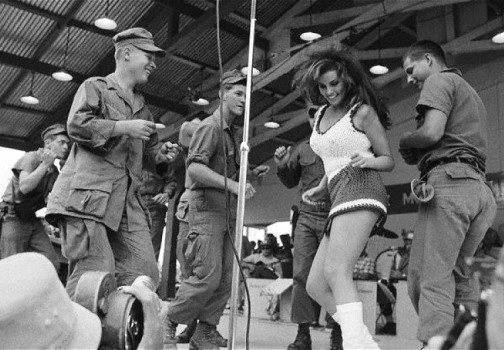
Operation Brute Force. That's what the soldiers, marines, and sailors are being rewarded for with the Playboy Bunnies. As I said in class today, this is a parody of the USO shows that traveled around Vietnam, entertaining the troops: always popular in those shows were the Hollywood starlets like Ann-Margret and Rachel Welch, singers and dancers, comedians, professional athletes, and even Playboy bunnies—though not like this. Critics often have commented on their costumes—cowboys, Indians, and cavalry. Just like another war not too dissimilar to Vietnam. And critics—and viewers watching closely—can't help but notice the swipe of the nose by the Playmate of the Year. A little toot of cocaine perhaps to get her up for the show?

 Arguably the film loses steam with the entrance today of Kurtz: Brando overweight and having improvised much of his own dialogue. But the attack on the village by Kilgore; the Playmates scene; and today, the deaths of Clean and Chief: they can't help but elicit a reaction from an audience.  As Emma said in class today, the Playmates make no sense here.  Then again, we're in a world of Generals who send assassins to kill their own officers; helicopter attacks set to the music of Wagner; and the horrific state of Kurtz's compound. More than ever, I feel unsettled as we make our way down the river in the movie. I can't see what you all look like during the movie: I hope you're all paying attention as difficult as this movie is.

Pick the first or the second question to answer. And everyone do number two and three.

1. The Playboy Bunny scene. Reaction to it? After you write that: why do you think it's here? The women egg the men on—act provocatively, entice them to come over (although I don't think they thought they actually would swim the moat)—but when the men come over, they begin happily signing the posters the men have: no one is groping them, just hoping for an autograph. At the same time we hear very clearly Lance (who loves puppies) shout, "You fucking bitch!" The guys on the boat are some of the loudest in the crowd of men—but they also are the most humanized men we see in the film. So: why? Are we supposed to feel disgust for the behavior of the men? At the behavior of the women? Both? Something else?

or 

1.  The death of Clean.  We've seen Clean rake the sampan with his machine gun, killing a group of civilians.  He calls the girl a "slope bitch" (I believe).  Yet after all the carnage is done, as he lifts his shades, the look on his face says he can't—or almost can't—believe what he's done.  At the Do Long bridge, he's like the scared kid he is as he watches the men get blown off the bridge.  And Chief, as he's done throughout the movie, takes care of him.  And when Clean is killed, Chief breaks down in tears as he holds Clean's hand.  Some of you may have hated these men when they killed the civilians.  What do you feel about them now, in and after this scene?  And what was your reaction to this scene? 

2. What stayed with you from today's viewing?  And why?

3. The film is about.... Finish that thought in a thoughtful sentence. You may love the film or hate it or not care about it: but don't just give a quick, throwaway respone.

For one or two: give a detailed, thoughtful response as well. Not three sentences, but several.

We'll finish the film Monday.  Look at the writing topics: tell me Monday what you're doing to write about. 

Thursday, October 27, 2016

Blog Ninteen. Apocalypse Now. "Someday This War Will Be Over."

KILGORE. Napalm, son. Nothing in the world smells like that. I love the smell of napalm in the morning. You know, one time we had a hill bombed for twelve hours...and when it was all over, I walked up. We didn't find one of them, not one stinking dink body. Th smell, you know that gasoline smell? The whole hill smelled like—victory.

INT. COMMAND COPTER - DAY. Looking down on the burning helicopter.
PILOT. They blew the shit out of it.
KILGORE. Fucking savages.
CO-PILOT. Holy Christ...I'm gonna get that dink bitch. Get over there, Johnny. Get the right skid right up her ass.

LUCAS. Your mission is to proceed up the Nuyng River in a Navy patrol boat. Pick up Colonel Kurtz's path at Nu Mung Ba, follow it and learn what you can along the way. When you find the Colonel, infiltrate his team by whatever means available and terminate the Colonel's command.
WILLARD. Terminate the Colonel?
CORMAN. He's out there operating without any decent restraint, totally beyond the pale of any acceptable human conduct. And he still in the field commanding troops.
JERRY [CIA]. Terminate. With extreme prejudice.
LUCAS. You understand, Captain, that this mission does not exist, nor will it ever exist...

CORMAN:  Walter Kurtz was one of the most outstanding officers this country's ever produced.  He was brilliant.  He was outstanding in every way.  And he was a good man, too.  A humanitarian man. A man of wit and humor.  He joined the Special Forces, and after that, his ideas, methods, became...unsound. Unsound...Well, you see, Willard, in this war, things get confused out there. Power, ideals, the old morality, and practical military necessity. But out there with these natives, it must be a temptation to be God. Because there's a conflict in every human heart, between the rational and irrational, between good and evil. And good does not always triumph. Sometimes, the dark side overcomes what Lincoln called the better angels of our nature.

WILLARD.  I was going to the worst place in the world and I didn't even know it yet. Weeks away and hundreds of miles up a river that snaked through the war like a main circuit cable plugged straight into Kurtz. It was no accident that I got to be the caretaker of Colonel Walter E. Kurtz's memory any more than being back in Saigon was an accident. There is no way to tell his story without telling my own. And if his story really is a confession, then so is mine. 

               In an instant, THEY ALL OPEN FIRE.  One of the Vietnamese 
               men is blown apart into the water, and the others are gunned 
               down in their tracks.

               All of them continue to fire their rifles and guns wildly, 
               yelling obscenities.  Willard has his .45 out but does not 
               shoot.

                                     CLEAN
                         Motherfuckers!

                                     CHEF
                              (weeping)
                         Let's kill them all!

                                     LANCE
                         Fucking cocksucker motherfuckers!

               Finally the Chief calls out to them.

                                     CHIEF
                         Hold it!  Hold it!

               They all stop firing, but Chef, Lance, and Clean are 
               mumbling hysterically.

                                     CHEF
                         Let's kill all the assholes!

                                     CHIEF
                         Chef, hold it!  Hold it!

                                     CHEF
                              (hysterically)
                         ...why not?

                                     CHIEF
                         Clean?

                                     CLEAN
                         I'm good.

                                     CHIEF
                         You okay, Lance?

                                     LANCE
                         Shit!  Fuck!

                                     CHIEF
                         Chef?

               Chef has moved to the yellow can that the Vietnamese girl 
               was sitting on.  He opens the lid and checks what she had 
               hidden.

                                     CHEF
                         Look what she was hiding.  She 
                         what she was running for?

               He reaches inside of the can, and pulls out a PUPPY.  They 
               all react.

                                     CHEF
                         A fucking puppy!  A puppy.

WILLARD.  It was a way we had over here of living with ourselves. We'd cut them in half with a machine gun, and give them a Band-Aid. It was a lie. And the more I saw of them, the more I hated liars. Those boys were never gonna look at me the same way again, but I felt like I knew one or two things about Kurtz, that weren't in the dossier.

I was laughing with Stuart when Kilgore's men talked about surfing—I mean, it is funny.  But clearly no one was laughing after the sampan scene; I could hear someone crying (Nell I soon discovered).  Some of you wouldn't look at me when I asked for your reaction to the movie so far.  It's okay: you didn't come to school today expecting what you saw.  I haven't seen Apocalypse Now since I last showed it in this class two years ago (and I've seen it and Apocalypse Now Redux both in the movie theater and probably a dozen times on television and in class); yet today, it was like watching it anew. And it was disquieting. Horrifying. Horrifyingly sad.  I never thought of it as a sad movie before today.  As Asiya and Alice both talked said, we like the PBR crew—I like the PBR crew: Chief, the tough professional commander of the boat who looks out for his men, particularly Clean, and rightly distrusts Willard;  Clean—"Mister Clean"—seventeen years old, all elbows and long legs, who really is just a kid; Lance the surfer who is all wide-eyed at the world around him; and Chef, who chose the Navy because he heard the food was better, and who vows "to never get off the boat."  
 They're our boys—not professional killers like Willard (and Kilgore), but just guys who'd rather be home surfing or cooking or hanging with their buddies.  And then they become killers, cold- blooded murderers.  Something was going to happen—Nell talked about the rising tension in the scene—but not this.  Not this madness.  And yet it's a beautifully filmed movie, a gorgeously filmed movie: particularly what we saw today: has anyone ever seen as unappetizing a meal as the roast beef and shrimp that Corman serves Willard? The choreography of the helicopter attack on the village? The surreal nature of the opening napalming of the jungle? The surreal nature of all of it, really: the surfing? Col. Kilgore?

The opening: Willard remembering what happened, much as Marlow does, relating his tale—but to whom?  "Everyone gets everything he wants. I wanted a mission, and for my sins, they gave me one. Brought it up to me like room service. It was a real choice mission, and when it was over, I never wanted another."  Coppola refuses to give into our desire for order and transparency. The narrative flies by so quickly that we are left wondering what to think. Kurtz is the bad guy, right? Willard the good guy? The attack on the village courageous and just? Corman's assessment of Kurtz is correct? Stop a minute and think about what's being said and what's being shown.

1. Reflection on the film so far? What moment, image, scene, jumped at you in particular—and why?

2. So far, where does the film overlap thematically with Conrad? How so?

3. Who are/is the good guy(s) here? Is there, are there, any? Who is/are the bad guy(s)? And why for both answers.

See you all tomorrow.


Sunday, October 23, 2016

Blog Eighteen. Heart of Darkness. "The Horror! The Horror!" (69).

"This is the reason I affirm that Kurtz was a remarkable man. He had something to say. He said it...He had summed up—he had judged. The horror!" (70)

"'The last words he pronounced was—your name.'"

I raised my head. he offing was barred by a black bank of clouds, and the tranquil waterway leading to the uttermost ends of the earth flowed sombre under an overcast sky—seemed to lead into the heart of an immense darkness. (77)

There it is. The most studied book in American college and university.  From this moment on, you'll begin to recognize all the references to the story that are around you—Donald Trump himself has been compared to Kurtz (William was ahead of that curve). It has never stopped resonating. I thought last night: fifteen years after its publication, World War One began. It made what King Leopold did to the Congo look like a tea party. And it was a war waged by men just like Kurtz and Marlow: the best and brightest of Europe. The same thing would happen in World War Two. Vietnam was the brainchild of the graduates of the greatest centers of American intellectualism, the Ivy Leagues. George W. Bush, who gave us The War on Terror and torture (sanctioned by Harvard educated lawyers), was a Yalie and Harvard Law School graduate. Barrack Obama, a graduate of Columbia and—surprise—Harvard Law School, refused to indict the architects of the Bush policy of "enhanced interrogation" (they violated international law), and has widened the scope of drone attacks, killing thousands. And the New York Times reported back when I last taught this book that the US enlisted a thousand former Nazis, including those involved in extermination, as spies, hiding this program until...well, now. Now where does that heart of darkness start? What Conrad saw so clearly was that the architects of one of the most horrible genocides in recent history were men like Kurtz—a poet and painter and musician, a good and moral man. Did the wilderness drive him mad? Was it his hollowness? What was it that turned him to the darkness? (Hmm...shades of Star Wars there perhaps)

1. So what is "The Horror" that Kurtz utters on his deathbed?

2. Why does Marlow lie to The Intended at the end? Marlow expects the heavens to fall on his head—but nothing happens. This is an act of mercy to the devastated woman—but it is also a terrible lie that allows her to think Kurtz was a good and moral man, the man she knew. Should Marlow have told her the truth?

3. What's the last paragraph of the story mean? What's its effect as the end of this tale?

In one of your answers above please quote. Write a couple hundred words, okay?  And finally, as a preview of our viewing of Francis Coppola's free adaptation of the book, here is a clip from Apocalypse Now, starring Marlon Brando as Colonel Walter Kurtz, soldier gone rogue in Vietnam, and Martin Sheen as Captain Benjamin Willard, soldier turned assassin.

See you all tomorrow.


Wednesday, October 19, 2016

Blog Seventeen. Heart of Darkness Through 54 (Part II). "He Had No Restraint, No Restraint—Just Like Kurtz—A Tree Swayed By The Wind" (51).

"His mother was half-English, his father was half-French. All Europe contributed to the making of Kurtz, and by and by I learned that most appropriately the International Society for the Suppression of Savage Customs had entrusted him with the making of a report for its future guidance"(49).

"The thing was to know what he belonged to, how many powers of darkness claimed him for their own. That was the reflection that made you creepy all over. It was impossible to imagine—it was not good for one either—trying to imagine. He had taken a high seat amongst the devils of the land—l mean literally. You can't understand? How could you—with solid pavement under your feet, surrounded by kind neighbors ready to cheer you or to fall om you, stepping delicately between the butcher and the policeman, in the holy terror of scandal and gallows and lunatic asylums—how can you imagine what particular region of the first ages a man's untrammelled feet may take him into by way of solitude—utter solitude without a policeman—by the way of silence—utter silence, where no warning voice of a kind neighbour can be heard whispering of public opinion. These little things make all the great difference." (49-50)

"Seventeen pages of close writing.  He had found time for it.  But this must have been before his—let us say—nerves went wrong and caused him to preside at certain midnight dances ending with unspeakable rites, which–as far as I reluctantly gathered from what I heard at various times—were offered up to him—do you understand—to Mr. Kurtz himself" (50). 

"'Exterminate all the brutes!'" (50).  

We're close.  We see Kurtz's house surrounded by "a dozen slim posts...ornamented with round carved balls" (52). We meet a wildly garbed "harlequin" who reveals that Kurtz "has enlarged [his] mind" (54). We've read some of what Kurtz has written.  We know his lineage.  All we have left is to see him in the flesh.

1. As we talked about the first day of discussing the book, we recognized that it is an adventure tale—a genre that includes Indiana Jones, as well as a zillion Kipling stories and bad, grade Z Hollywood and Brit movies of the 30s and 40s (by the 50s they were pretty much dead, unless it was George Lucas reliving his childhood movie watching habits in the Indiana Jones series: and who can complain when the bad guys are Nazis?). The story, as we said in class, is the intrepid adventurer goes into the wild and makes things right. While not a parody in the way Voltaire approached the picaresque, this is a warped adventure story. How so—and to what purpose?

2.  The significance of Kurtz's lineage, as quoted above? 

3. What is Marlow trying to impress on his listeners in the second quote above?  Quote a couple times from the passage.

 Tomorrow I want to hear about your discussion in class yesterday.  I hope you all are doing well: juniors, survived the PSAT and seniors...well, survived sleeping late I assume.  See you folks tomorrow. 

Sunday, October 16, 2016

Blog Sixteen. Heart of Darkness Through 44. "I Listened." (27)

"There was not a word from anybody.  The others might have been asleep, but I was awake. I listened.  I listened on the watch for the sentence, for the word that give me the clue to the faint uneasiness inspired by this narrative that seemed to shape itself without human lips in the heavu night-air of the river..." (27).

"As for me, I seemed to see Kurtz for the first time.  It was a distinct glimpse: the dugout, four paddling savages, and the lone white man turning his back suddenly on the headquarters, on relief, on thoughts of home perhaps, setting his face towards the depths of the wilderness...I do not know his motive" (32).

"Where the pilgrims imagined it crawled to I don't know.  To some place where they expected to get something, I bet!  For me it crawled toward Kurtz..." (35).

We're close to Kurtz.  Only eight miles down the river.  And with Kurtz, the meaning of Marlow's story will come into focus.  Or so can only hope.

1. Marlow thinks his audience isn't listening—but they are, particularly the narrator.  What interest could they have in this story that does not always support their view of empire, colonization, imperialism, and themselves?

2.  Marlow is looking for Kurtz.  That's it.  Why?  We'll find out more soon, but from what we've read already—what is the lure of Kurtz to Marlow?

That's enough to start us up again.  Go ahead and quote in one of your responses.  I hope your break was relaxing.  A big chunk of uninterrupted school time coming up.  Yay!

See you all tomorrow.